
Updated for FEMA's October 2025 Flood Insurance Manual
Does Flood Insurance Cover Your Basement? Why Most Finished Basements Are Barely Covered
Your finished basement may be covered for far less than you think. Here's what a flood policy pays for below ground, and why the right foundation type is the key to the coverage you expect.

Reviewed by Aaron J. Farmer, licensed flood specialist CA License #0L75450 · Last reviewed November 4, 2026
Picture a finished basement: carpet, painted drywall, a sectional, a big TV, maybe a bar and a pool table. Now picture two feet of floodwater in it. Most homeowners assume their flood policy would replace all of that. Under a standard National Flood Insurance Program (NFIP) policy, it would pay for the furnace, the water heater, the clean-up and, if you carry contents coverage, the washer and dryer. Almost everything else in that room isn’t covered.
In our experience, there are two things most homeowners with a lower level don’t know. First, how little a basement is actually covered for. Second, that your home’s actual foundation type (basement, walkout or something else) decides which parts of it get full coverage, and getting it right on your policy is how you find that out before a claim does. Getting the foundation type right is the key to getting the coverage you should get. This guide explains both, then covers drain backup and sump pumps, private flood options, and how to check your own home.
What flood insurance really covers in a basement
NFIP basement coverage is a list, not a blanket. If an item isn’t named, it isn’t covered below ground. FEMA puts it plainly in a published appeal decision: “Any personal property located in a basement that is not one of these named items, is not covered.”
| In your basement: covered | In your basement: not covered |
|---|---|
|
|
Summarized from the Standard Flood Insurance Policy, Sections III.A.8 and III.B.5. Contents items must be installed in their working location and, if needed, plugged in. FEMA’s policy commentary adds that the policy doesn’t pay to remove items it doesn’t cover, “even if the removal of the items is done to facilitate cleanup or repair of the insured building, such as the removal of carpet installed inside a basement” (FEMA SFIP Commentary, June 2025).
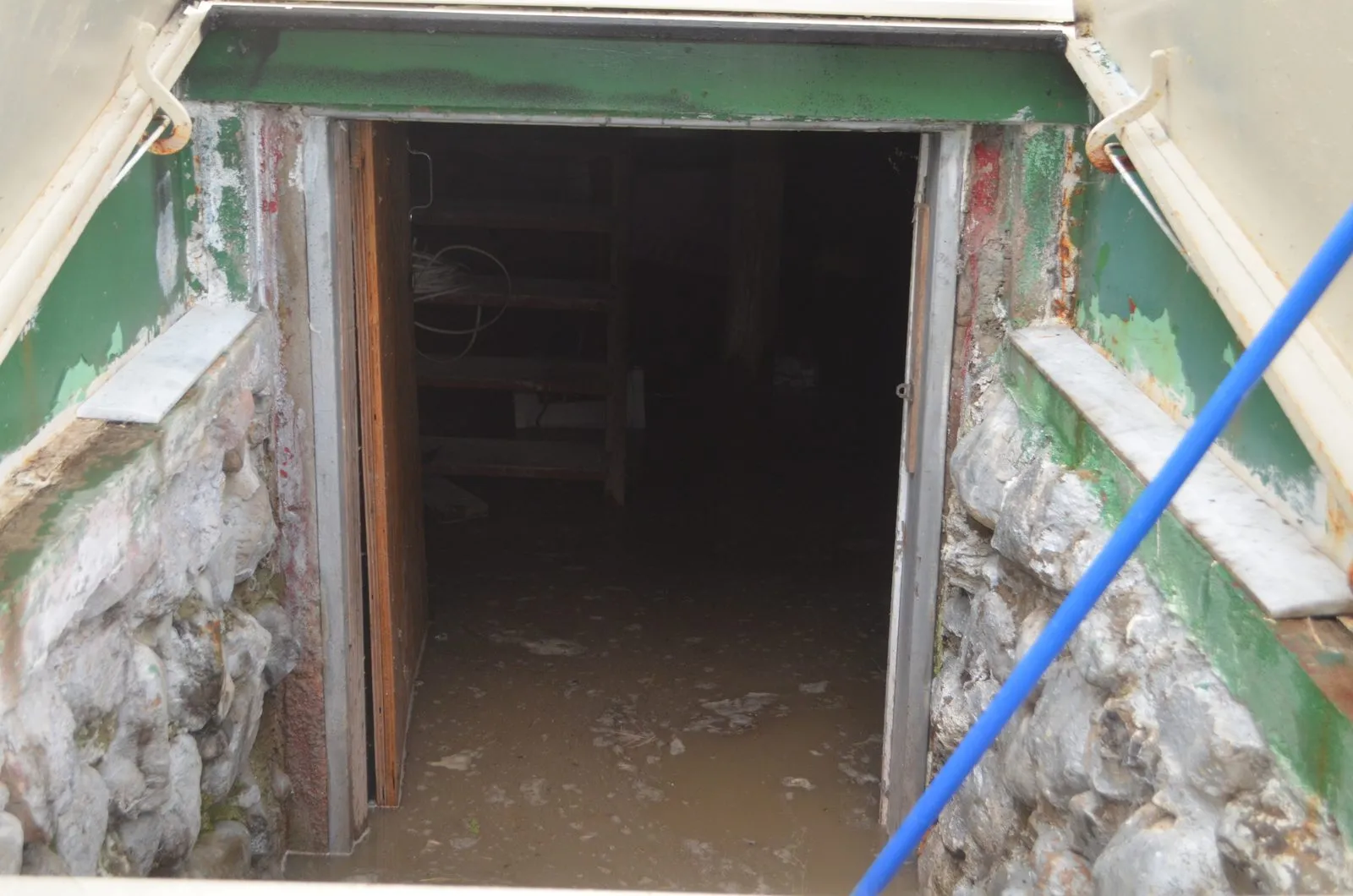
That’s why the finished basement, the “man cave,” is one of the biggest gaps in flood coverage. The things that make it a living space are exactly the things the policy leaves out. It’s also a very common gap: of the roughly 39 million U.S. homes with a basement, about 23 million have a finished one, according to the U.S. Energy Information Administration’s 2024 housing survey. FEMA’s guidance for agents lists couches, televisions and family keepsakes, along with “finished flooring, finished walls, bathroom fixtures, and other built-ins,” as items that aren’t covered. The damage adds up fast. FEMA estimates that “just one inch of water in an average size home can cause roughly $25,000 of damage” (FloodSmart). A flooded basement usually holds a lot more than an inch.
One practical step helps with the items that are covered: write down the make, model, serial number and capacity of your furnace, water heater, washer, dryer and freezer now. FEMA’s NFIP claims handbook lists those details among the information to have ready for a claim. See what flood insurance doesn’t cover for the full list of exclusions.
What counts as a basement for flood insurance?
Here’s the good news for some homeowners: not every lower level counts as a basement. In many cases, the ones that don’t count aren’t held to that short list. For flood insurance, a basement is any part of the building whose floor is below ground level on all sides. The federal definition in 44 CFR 59.1 reads: “any area of the building having its floor subgrade (below ground level) on all sides.” The flood policy adds that a sunken room, or even a sunken part of a room, counts too.
FEMA’s training for flood professionals puts it bluntly: “It doesn’t matter what anybody living or working there does with it or calls it—if the floor is below ground level on all sides, then the area meets the definition of a basement” (FEMA Emergency Management Institute). In practice, that means:
- A finished basement is still a basement. FEMA’s manual says a floor below grade on all sides is a basement “even if the floor is used for living purposes, or as an office, garage, workshop, etc.”
- An underground garage can be a basement. FEMA’s building diagrams for basements include a “basement or underground garage” below grade on all sides.
- A split-level home can go either way. If the bottom floor is below grade on all sides, it’s a basement. If it’s at or above grade on at least one side, it isn’t.
Full, daylight and walkout basements compared
The three common kinds of basement split two ways under FEMA’s rules. A full basement, and a daylight basement whose floor is below ground on every side, are basements. A true walkout is not.
| Full basement | Daylight basement | Walkout basement | |
|---|---|---|---|
| What it looks like | Floor below ground on all sides. Small windows in window wells, if any. | Floor below ground on all sides, but the walls rise high enough above ground for full-size windows on one or more sides. | Built into a slope. On the downhill side the floor meets the yard, usually with a door you can walk straight out of. |
| FEMA foundation type | Basement | Basement, as long as the floor is below ground on every side | Elevated With Enclosure Not on Posts, Piles or Piers |
| NFIP basement coverage limits? | Yes, in every flood zone | Yes, in every flood zone, if the floor is below ground on every side | Only for newer homes in certain high-risk zones (see below) |
Two details decide most borderline cases:
- Windows don’t count. The floor does. A daylight basement with big windows is still a basement if you can’t find a side where the floor is at or above the ground outside. “Daylight basement” is used loosely, so go by the ground, not the name.
- An outside door doesn’t make it a walkout. Many full basements have a door at the bottom of an outdoor stairwell or bulkhead. FEMA’s manual describes this case: “the door and area of egress is also below ground level on all sides.” That’s still a basement. A walkout door opens onto ground that is level with the floor.
For a true walkout, FEMA’s manual tells agents directly: “If the building has a ‘walkout basement,’ refer to foundation type Elevated with Enclosure Not Posts, Piles, Piers.” FEMA treats the main floor as an elevated floor on full-height foundation walls. The walkout level is the enclosure below it. In one appeal decision published on FloodSmart, FEMA reversed a basement classification after an engineer’s survey showed the floor was above ground level, so the test is applied literally.
The walkout catch: zone and building age
Being correctly rated as a walkout doesn’t automatically mean full coverage on that level. The flood policy applies the same short list of covered items to any basement, in any zone. It also applies that list to anything below the lowest elevated floor of a post-FIRM elevated building in Zones A1–A30, AE, AH, AR (and its combinations), V1–V30 or VE (SFIP Sections III.A.8 and III.B.5). Post-FIRM means construction or substantial improvement after December 31, 1974, or on or after the community’s first flood map took effect, whichever is later. In plain terms:
- Full or daylight basement: limited coverage in any zone, for a home of any age.
- Walkout in a lower-risk zone such as Zone X, in an unnumbered Zone A, AO or A99, or in an older pre-FIRM home: the walkout level generally isn’t held to the basement list. Those zones aren’t on the policy’s list.
- Walkout in a newer home in Zone AE, VE, AH or a numbered A zone: expect the same short list of covered items on the walkout level.
So calling a walkout a “basement” can mean paying for the wrong rating, and it invites an argument over which coverage limits apply when you file a claim.
Where basements are common
Basements are a regional question. In 2024, 30% of U.S. homes had a basement, according to the U.S. Energy Information Administration’s Residential Energy Consumption Survey. The share runs from about two-thirds of homes in Pennsylvania and Michigan, and more than half in Minnesota, Connecticut, Ohio, Missouri, Utah and Illinois, down to 5% in California and 2% in Arizona.
If you live in one of the high-basement states, the rules on this page are the ones most likely to apply to you. See our state guides for Pennsylvania, Michigan, Ohio, Illinois, Missouri, New York, New Jersey, Connecticut and Colorado.
Sump pumps, drain backup and seepage
Water in a basement isn’t always a flood, and the flood policy draws that line carefully. Section V.D.5 of the Standard Flood Insurance Policy excludes water that “backs up through sewers or drains,” “discharges or overflows from a sump, sump pump, or related equipment,” or “seeps or leaks on or through the insured property,” unless “there is a flood in the area and the flood is the proximate cause.”
A flood, in the policy’s words, is “a general and temporary condition of partial or complete inundation of two or more acres of normally dry land area or of two or more properties (one of which is your property).” So:
- Covered, within basement limits: an overflowing river or flash flood surrounds the neighborhood, and the water comes in through the floor drain or swamps the sump pump. Even then, in a basement, only the listed items above are paid for.
- Not covered by flood insurance: a heavy storm with no general flooding, and the sump pump fails or the city sewer backs up into your floor drain. Groundwater seeping through a cracked wall on a dry week isn’t covered either.
The sump pump itself is on the list of covered basement items when a covered flood damages it. For backup with no general flooding, ask your homeowners insurer about a water backup endorsement, especially if your basement is finished.
Can private flood insurance cover a finished basement?
Sometimes. Nevada’s insurance regulator puts it this way: “A private flood insurance policy may cover property located in finished basements, which is generally excluded from coverage by the NFIP” (Nevada Division of Insurance). For example, Neptune Flood offers an optional basement contents endorsement of up to $10,000 that “expands the list of covered basement contents not included in a standard policy,” as described on Travelers’ flood insurance page.
The key word is “may.” Each private policy defines basements and enclosures its own way. Some copy the NFIP’s limits, and some add limits of their own. Before you rely on any policy for a finished lower level, check three things in the actual wording:
- How it defines “basement,” and whether a walkout level is treated differently.
- Whether finished walls, flooring and built-ins below grade are covered or excluded.
- Whether basement contents are covered, and up to what limit.
We compare the NFIP with up to nine private flood markets, so we can run this side-by-side check for your home. For the bigger picture, see private flood vs. NFIP coverage.
When a crawlspace counts as a basement
A crawlspace with its floor below ground on all sides is a “subgrade crawlspace,” and FEMA lets it stay a crawlspace only within strict limits. Under the manual, the crawlspace floor can be “no more than 5 feet below the top of the next higher floor” and “no more than 2 feet below the Lowest Adjacent Grade” on all sides. The Lowest Adjacent Grade is the lowest point of the ground next to the house. Go past either limit and FEMA treats it as a basement.
The other foundation types at a glance
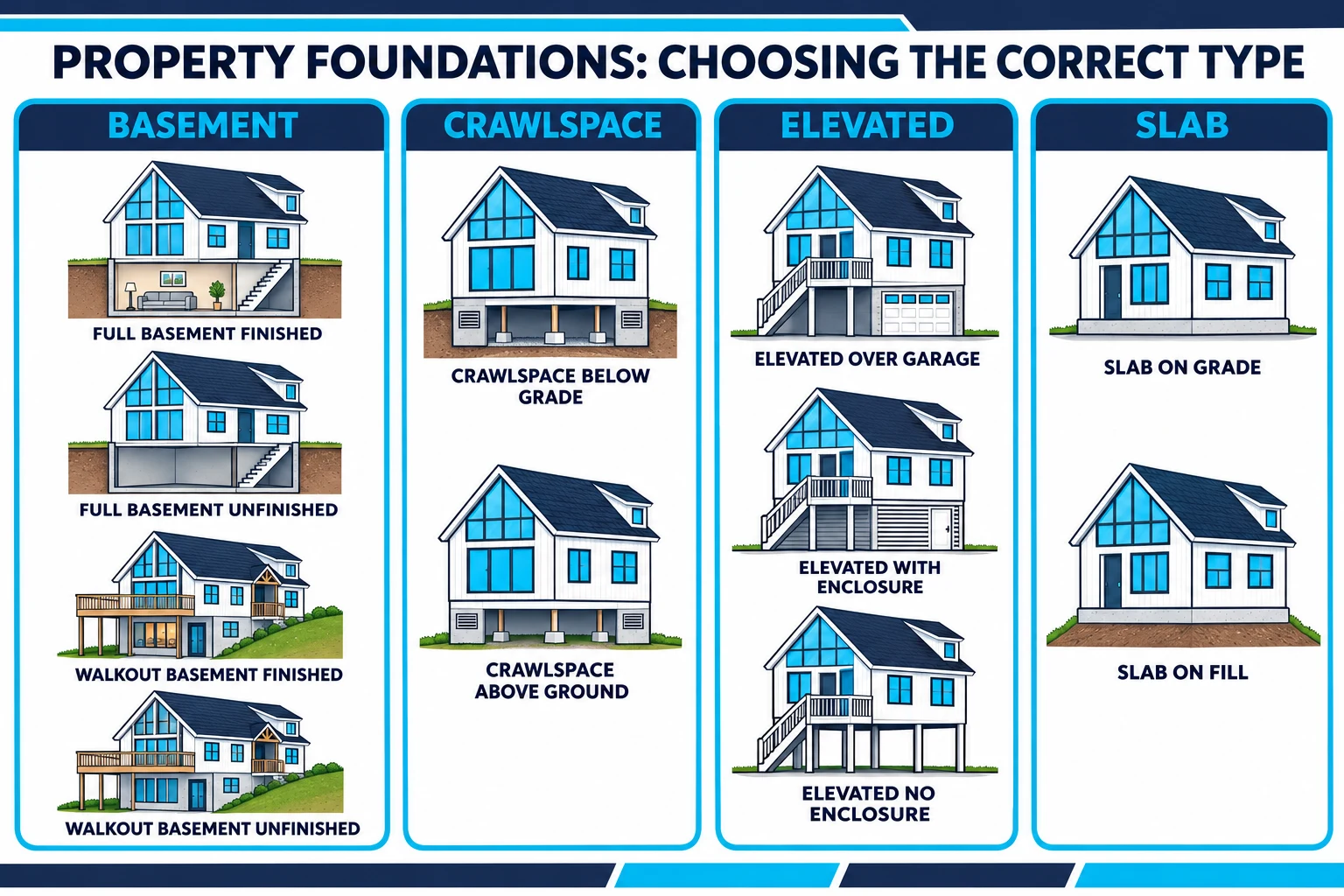
If your home has no basement, it still falls into one of FEMA’s six foundation types. Here is how the rest of our quote form maps to them. For a full walkthrough of crawlspaces, elevated homes, garage-under homes and slabs, see our California team’s guide to flood insurance foundation types.
| On our quote form | FEMA foundation type |
|---|---|
| Full basement (finished or unfinished) | Basement |
| Walkout basement (finished or unfinished) | Elevated With Enclosure Not on Posts, Piles or Piers |
| Crawlspace below grade | Crawlspace (subgrade). Basement if more than 2 ft below grade or more than 5 ft to the floor above |
| Crawlspace above ground | Crawlspace. Elevated With Enclosure Not on Posts, Piles or Piers if more than 5 ft to the floor above |
| Elevated over garage | Elevated With Enclosure (on posts, piles or piers, or on masonry walls). Slab on Grade if frame walls sit on a full slab |
| Elevated with enclosure | Elevated With Enclosure (on posts, piles or piers, or on solid walls) |
| Elevated, no enclosure | Elevated Without Enclosure (lattice or screening still counts as no enclosure) |
| Slab on grade or slab on fill | Slab on Grade |
What happens if your policy lists the wrong foundation?
This is where the foundation type really earns its place on the application. The policy only provides the coverage your premium actually paid for, and the coverage itself follows the building you really have. Section VII.D of the flood policy covers what happens when the premium or rating information was insufficient: “we will provide only the kinds and amounts of coverage that can be purchased for the premium payment we received.” FEMA’s manual requires the insurer to correct (in FEMA’s word, “reform”) the policy whenever it finds the problem, “at writing, endorsement, renewal, or before or after a loss.”
- If the correct rating costs more and you pay the bill within 30 days (and supply any missing rating information within 60 days), your full coverage is restored and the claim is settled on the amount you originally bought. If you tell the insurer within those 30 days, you can ask it to deduct the extra premium from the claim payment.
- If you don’t pay, the policy says “any flood insurance claim will be settled based on the reduced amount of coverage.” Paying late doesn’t rescue an existing claim. Full coverage comes back only by endorsement, after a 30-day waiting period.
- If the correct rating costs less, FEMA refunds the difference back to the date the error started, up to 5 years before the start of the current policy term.
FEMA’s published appeals show how this plays out. In appeal decision A8, a townhome in Zone AE was listed as elevated but was actually built on a slab on fill. The insurer applied elevated-building coverage limits to the lower level. After a FEMA General Adjuster re-inspected the building, FEMA ruled it non-elevated, removed those limits and reformed the policy to the correct description.
We’ve seen the opposite case too. A homeowner’s appraisal said “slab,” but her home was actually elevated. Her private flood policy mirrored the NFIP’s limits for the area below an elevated floor, so after a flood most of what was on her ground level had no coverage. Correcting the description wouldn’t have added that coverage, but knowing it beforehand would have helped: she could have moved belongings up or looked for a policy that covers that area. Check before a flood, not after.
Misstating the foundation on purpose is far more serious. Section VIII.A of the policy makes it void if you or your agent “concealed or misrepresented any material fact or circumstance.”
How to check your basement in 10 minutes
- Walk all four sides. Is the lower level’s floor below the ground outside on every side? If yes, it’s a basement (or a subgrade crawlspace if it’s shallow). If any side is at ground level, it’s not a basement.
- Look at the doors. A door you can walk straight out of onto the yard usually means a walkout. A door at the bottom of outdoor steps doesn’t.
- Measure shallow spaces. For a crawlspace, measure how far its floor sits below the outside ground and how far it is to the top of the floor above.
- Check your elevation certificate if you have one. Diagrams 2A, 2B and 4 are basements, Diagram 7 covers walkouts and other homes on full-story foundation walls, and Diagrams 8 and 9 are crawlspaces. An elevation certificate isn’t required for NFIP rating, but if you send one, FEMA compares the premium using it with the premium using its own data and uses whichever is lower (FEMA Flood Insurance Manual). See our elevation certificate guide.
- Don’t copy it from paperwork. Appraisals, listings and tax records often get foundation type wrong. They weren’t written for flood insurance.
- Send your agent photos of every side of the house and the lower level, plus the equipment list from above.
Two discounts worth asking about
FEMA offers a mitigation discount for raising your home’s machinery and equipment. Under the October 2025 Flood Insurance Manual, all of the listed equipment has to be elevated to within a foot of the required floor, which for a basement home means the floor above the basement. Alternatively, it can sit at or above the base flood elevation, with an elevation certificate or other documentation. For building coverage, the list is the central air conditioner and heat pump (including outdoor compressors), furnace, water heater, and any elevator or solar battery equipment. If you also insure contents, the washer, dryer and freezer have to be raised too. Moving one appliance alone won’t qualify.
Crawlspace and enclosure foundations may also qualify for a discount for proper flood openings, the vents that let water flow through instead of pushing on the walls, according to FEMA’s Risk Rating 2.0 guide for single-family homes.
Not sure which picture matches your home? Call 855-225-3566 or start a quote and mention you have photos. A licensed specialist will help you choose the right foundation type before anything is issued, then compare the NFIP with up to nine private flood markets. If you already have a policy, our flood claim guide explains what an adjuster looks at after a loss.
Watch: FEMA explains NFIP basement coverage
Video from FEMA’s YouTube channel. Watch on YouTube.
Common questions
Is a walkout basement considered a basement for flood insurance?
Not under the NFIP. A basement must have its floor below ground level on all sides, and a walkout’s floor is at ground level on at least one side. FEMA’s manual tells agents to rate a walkout as an elevated building with an enclosure on solid foundation walls. In newer homes in zones such as AE or VE, the walkout level can still get limited coverage as an enclosure.
Is a daylight basement a basement for flood insurance?
It depends on the ground, not the name. “Daylight basement” is used loosely. If the floor is below the ground outside on every side, it’s a basement, however big the windows. If the floor is at or above ground level on even one side, it isn’t a basement, door or no door. FEMA then rates it by how it’s built, usually as elevated with an enclosure if the lower walls are full-height concrete or block.
Does flood insurance cover my finished basement or man cave?
Only a small part of it. NFIP policies don’t cover the finishes. In a basement they cover a named list of items, such as furnaces, water heaters, washers, dryers and freezers, plus unfinished drywall and clean-up. Finished walls and floors, carpet, furniture and electronics aren’t covered. Some private flood policies offer broader basement coverage, and others are stricter.
Is water from a failed sump pump or a backed-up drain covered?
Only if a flood caused it. The flood policy excludes sewer and drain backup, sump pump overflow and seepage unless there is a flood in the area and the flood is the proximate cause. Even then, in a basement, only the named list of items is covered. For backup with no general flooding, ask your homeowners insurer about a water backup endorsement.
Does my flood zone change basement coverage?
Not for a true basement. Basement limits apply in every flood zone. Zone does matter for walkouts and other enclosures, because those limits apply only to post-FIRM elevated buildings in zones such as A1–A30, AE, AH, AR, V1–V30 and VE, not in Zone X or in unnumbered Zone A, AO or A99.
What if my flood policy lists the wrong foundation type?
Coverage follows the building you actually have. Under the NFIP, if the correct rating costs more, a claim can be paid on reduced coverage unless you pay the difference within 30 days of the bill. If it costs less, you can get a refund going back up to 5 years. Fix it before a flood, using photos of the house rather than an appraisal or listing.
Does homeowners insurance cover a flooded basement?
Not if the water comes from a flood. FEMA says “most homeowners insurance does not cover flood damage” (FloodSmart). Many homeowners insurers sell a water backup endorsement for a backed-up drain or failed sump pump with no flooding outside, but that isn’t flood coverage. For floodwater you need a flood policy, and even then basement coverage is limited to a named list of items.
Is a sunken living room a basement for flood insurance?
It can be. The flood policy’s definition of a basement includes “any sunken room or sunken portion of a room” whose floor is below ground level on all sides (Standard Flood Insurance Policy, Section II.C). If the sunken floor is at or above the ground outside on at least one side, it isn’t a basement.
Is a crawlspace a basement for flood insurance?
Usually not. A crawlspace below ground on all sides stays a crawlspace only if its floor is no more than 2 feet below the outside ground and no more than 5 feet below the top of the floor above. Past either limit, FEMA rates it as a basement.
Sources: FEMA, NFIP Flood Insurance Manual, October 2025 edition (Section 2, Reformation; Section 3, Foundation Type, Tables 8–13; Section 4, Rating Correction); Standard Flood Insurance Policy, Dwelling Form, 44 CFR Part 61, Appendix A(1), Sections II.B, II.C, III.A.8, III.B.5, V.D.5, VII.D and VIII.A; 44 CFR 59.1; FEMA Emergency Management Institute, IS-1109.a; FEMA FloodSmart appeal decisions (basement classification overturned; A8, elevated post-FIRM overturned); FEMA agent resources on basement coverage (April 2024) and the cost of flooding (December 2023); FEMA NFIP Claims Handbook (August 2024); FEMA SFIP Commentary (June 2025); FloodSmart eligibility FAQ; FEMA Risk Rating 2.0 Simple Guide for Single-Family Homes; U.S. Energy Information Administration, Residential Energy Consumption Survey 2024, state structural characteristics (preliminary, March 2026) and Table HC2.4; Nevada Division of Insurance; Travelers flood insurance page (Neptune endorsements). Reviewed November 4, 2026.
Get a flood quote for your property
A licensed specialist compares available private markets and the NFIP, then explains the options in plain English — including when the NFIP is the better fit.